How to Review a Multi-Team Call Route After Launch
An inbound call route is never finished on launch day. Regularly auditing real caller handoffs with receiving teams keeps transfers accurate and ensures every fallback has an explicit owner.
When an operations team designs an inbound call route, the initial architecture is based on best assumptions: how callers describe their problems, which departments handle specific requests, and how transfers should flow. But once an inbound route is handling live volume across multiple teams or locations, real-world calling patterns inevitably reveal friction.
Departments reorganize, new services launch, and callers describe their needs in ways an initial prompt tree never anticipated. Without deliberate operational upkeep, small routing mismatches compound: service reps field billing questions, urgent requests land in general voicemail boxes, and receiving teams grow frustrated by misdirected transfers.
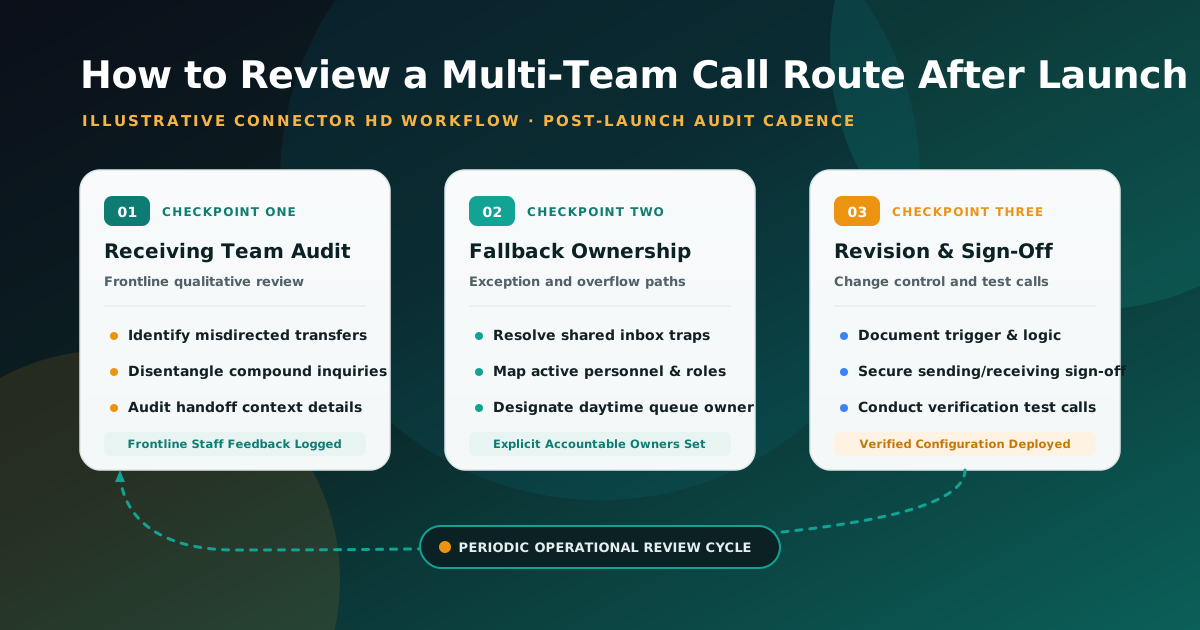
To maintain a reliable inbound experience, an operations manager must treat call routing as an ongoing operational discipline. Reviewing a multi-team call route after launch does not require complex automated telemetry or proprietary analytics dashboards. It requires a structured operational cadence that answers three essential questions:
- Which caller situations are creating friction for receiving teams?
- Where is fallback or overflow ownership ambiguous or outdated?
- What explicit decision and team sign-off must be recorded before updating the live route?
Here is how to conduct a periodic review of your active multi-team call routes, resolve operational ambiguities, and record verified route adjustments before modifying your live phone system.
1. Review caller situations directly with receiving teams
An operations manager sitting in an office cannot evaluate call-routing accuracy in isolation. The people who know whether a route is working are the frontline staff answering transferred calls every day.
Rather than waiting for informal complaints, schedule a structured 30-minute review with team leads from each receiving department (e.g., Sales, Customer Service, Billing, Field Dispatch). Focus the discussion on four specific caller situations:
Misdirected transfers
Ask receiving teams to identify the calls that consistently land on their desks but belong elsewhere.
- Did the caller choose a department based on outdated terminology?
- Did an initial intake prompt confuse two similar service offerings?
- Did a caller ask for a specific individual who has moved to another role or department?
When receiving staff have to manually transfer a caller a second time, document the caller's stated reason for reaching out, the department they were initially sent to, and the team that actually resolved their issue.
Ambiguous or compound inquiries
Many inbound callers do not arrive with a single, clean objective. A customer might call to pay an invoice, but simultaneously ask to reschedule tomorrow's service appointment.
- Which team should receive a caller whose request spans two departments?
- Should the route prioritize the immediate financial transaction or the scheduling operational need?
- Does the first receiving team know how to smoothly hand off the secondary request once their portion is complete?
Reviewing compound inquiries helps you establish clear routing hierarchies so the agent or initial flow knows which primary outcome takes precedence.
Unexpected caller questions and edge cases
Over time, businesses introduce new products, modify service areas, or encounter seasonal surges. Callers naturally ask about these developments before formal phone menus are updated.
- What recurring questions are frontline staff hearing that have no clear destination in the current call flow?
- Are callers asking about out-of-scope services that should be disqualified or redirected during initial intake?
- Are regional callers reaching headquarters when their request should route directly to a local branch?
Cataloging these recurring edge cases allows operations leaders to either expand the intake questions or create dedicated branch paths before callers reach busy staff.
Missing transfer context
As outlined in our guide on carrying context with a transferred call, a transfer should be a continuation of a conversation, not a fresh start.
- Are receiving teams receiving the caller's name, verified callback number, and core issue summary before they pick up?
- Are staff forced to ask callers to repeat information they already gave during initial intake?
If context is dropping between the initial intake and the receiving department, the transfer mechanism needs operational calibration.
2. Identify and resolve route and fallback ownership ambiguity
A call route is only as strong as its exception handling. While the primary path to an active team is usually well-defined, breakdowns most frequently occur when the primary recipient cannot answer.
During your post-launch review, examine every route's fallback mechanism to identify three common ownership traps:
The “everybody's problem” fallback trap
When a receiving team is occupied, on another line, or temporarily unavailable, where does the call go?
- If the fallback destination is a general company inbox, an unassigned voicemail queue, or a shared ring group, ownership is effectively absent.
- Shared queues create diffusion of responsibility: everyone assumes someone else will return the call, resulting in delayed follow-up or lost opportunities.
Every fallback path must terminate with a named role or explicit primary owner responsible for reviewing and returning calls within an agreed operational window.
Outdated personnel and reorganized departments
In growing companies, internal org charts evolve rapidly. Lines originally mapped to a specific specialist may now route to an unmonitored desk.
- Have receiving team phone numbers, extension mappings, or team inboxes changed since launch?
- Have responsibilities shifted between departments (for example, warranty intake moving from Sales to Customer Support)?
- Are calls still routing to former employees or discontinued department lines?
Auditing destination endpoints against your current staff directory ensures calls are delivered to active, accountable team members.
After-hours and overflow alignment
Inbound calls do not stop when the office closes. As detailed in our guide on giving after-hours call paths a daytime owner, an after-hours flow must have a designated daytime handler.
- Who opens the queue of messages, intake summaries, or emergency escalation alerts at the start of the next business day?
- Does the after-hours intake capture sufficient details for daytime staff to act without calling back simply to ask basic triage questions?
- Is there a clear distinction between routine after-hours inquiries (which wait for morning review) and true operational emergencies that trigger an immediate human escalation path?
Resolving these ambiguities turns fallback handling from an ad-hoc scramble into a predictable operational routine.
3. Record route revisions and secure team sign-offs before editing
Modifying a live call route without formal cross-team agreement is a recipe for operational chaos. When an operations manager tweaks a routing rule to solve a problem for Sales, they may inadvertently create an unmanageable flood of misdirected calls for Customer Support.
Before logging into your platform or requesting configuration updates, follow a disciplined three-step revision protocol:
Step 1: Document the proposed change and operational rationale
For every proposed modification, record:
- The triggering issue: The specific misdirected call pattern, ambiguous fallback, or internal reorganization that requires the change.
- The affected caller intent: The exact caller phrases, needs, or criteria that will trigger the revised path.
- The new routing logic: The updated prompt wording, the modified destination endpoint, and the specific fallback owner.
- The expected operational impact: Which team's inbound volume will increase or decrease as a result.
Step 2: Secure explicit sign-offs from all affected teams
Present the documented change to the leads of both the originating and receiving departments:
- Does the receiving team have the capacity and staffing coverage to handle the redirected call volume?
- Does the receiving team agree that these caller situations belong under their operational purview?
- Do staff understand what context will accompany the transferred call so they can handle it efficiently?
Never deploy a route change until both the team sending the call and the team receiving the call have formally signed off on the updated definition.
Step 3: Execute in-platform and conduct verification test calls
Once sign-offs are secured, implement the update:
- Under the Connector HD service terms, initial call flows are established with sales-assisted support, while subsequent routing changes can be made directly in the platform, with support available for additional assistance.
- Before directing live caller traffic through the revised path, place test calls simulating both the standard route and the fallback condition.
- Verify that the prompt guidance is clear, the transfer connects to the correct endpoint, caller context arrives intact, and fallback notifications reach the assigned owner.
4. Periodic multi-team route review worksheet
Use this blank operational worksheet during your monthly or quarterly route reviews. Completing this grid with department leads ensures that every active path has verified ownership and an agreed fallback before changes go live.
| Route / Caller intent | Primary receiving team | Verified destination endpoint | Fallback owner (if busy/unavailable) | Identified friction or misdirection | Proposed revision & sign-off status |
|---|---|---|---|---|---|
| e.g., Routine Service Request | Operations / Dispatch | Line / queue identifier | Named dispatch supervisor | Callers with billing questions routed here | Split billing prompt; sign-off pending Billing Lead |
| Route 1: [Caller Intent] | [Team Name] | [Phone / Endpoint] | [Specific Role / Owner] | [ ] None / [ ] Misdirected calls noted | [ ] Approved / [ ] Pending sign-off |
| Route 2: [Caller Intent] | [Team Name] | [Phone / Endpoint] | [Specific Role / Owner] | [ ] None / [ ] Misdirected calls noted | [ ] Approved / [ ] Pending sign-off |
| Route 3: [Caller Intent] | [Team Name] | [Phone / Endpoint] | [Specific Role / Owner] | [ ] None / [ ] Misdirected calls noted | [ ] Approved / [ ] Pending sign-off |
| Route 4: [Caller Intent] | [Team Name] | [Phone / Endpoint] | [Specific Role / Owner] | [ ] None / [ ] Misdirected calls noted | [ ] Approved / [ ] Pending sign-off |
| After-Hours / Overflow | [Designated Daytime Team] | [Summary / Queue Endpoint] | [Morning Queue Reviewer] | [ ] None / [ ] Unclear triage noted | [ ] Approved / [ ] Pending sign-off |
5. An illustrative scenario: How a regional commercial service company audits active routes
To see how an operations manager applies this framework in practice, consider the following operational scenario:
Illustrative Example
A regional commercial HVAC and refrigeration contractor with three branch offices and sixty field technicians implemented an inbound AI phone agent to handle 24/7 customer calls. Sixty days after launch, the operations director convenes a quarterly route review with the Service Dispatch Manager, the Commercial Sales Lead, and the Accounting Supervisor.
- Phase 1: Identifying misdirected transfers: During the review, the Service Dispatch Manager reports that dispatchers are fielding 15 to 20 calls per week from existing commercial clients asking about invoice balances and maintenance contract renewals. Because the initial prompt tree grouped all “existing contract inquiries” under Service, dispatchers were spending valuable triage time manually redirecting callers to Accounting.
- Phase 2: Resolving fallback ambiguity: The review also uncovers that when the Commercial Sales line was busy during peak morning hours, the route defaulted to an unmonitored general company inbox. Prospective clients requesting new installation bids were leaving messages that went unreviewed for up to 48 hours. The team resolves this ambiguity by designating the Sales Operations Coordinator as the explicit fallback owner, receiving immediate SMS and email alerts for all uncompleted sales transfers.
- Phase 3: Formalizing sign-offs and testing: The operations director documents two specific route changes: (1) splitting the “contract inquiry” prompt so that invoice and billing questions route directly to Accounting, and (2) reassigning the sales overflow fallback to the Sales Operations Coordinator. Both the Accounting Supervisor and Commercial Sales Lead sign off on the revised descriptions. The operations director updates the configuration in the platform and places three verification test calls to confirm that transfers connect accurately and fallback notifications dispatch properly before announcing the update to staff.
This scenario is an illustrative operational example designed to show cross-team review methodology; it does not represent an actual customer endorsement, proprietary integration, or specific performance outcome.
6. How Connector HD supports multi-team inbound operations
At Connector HD, our philosophy is that an inbound phone agent must actively connect callers to an outcome—routing to the right team, booking an appointment, qualifying a lead, or executing a clean human handoff—rather than acting as a passive message-taking line.
Clear, predictable commercial terms
Connector HD provides dependable inbound call automation under straightforward terms:
- Standard subscription: The standard AI Phone Agent subscription is $249 per month, billed month to month.
- Zero upfront fees: There is no setup or onboarding fee ($0).
- Included monthly allowances: Each monthly billing period includes 500 inbound minutes and 500 SMS text messages.
- Metered overages: Usage beyond monthly allowances is billed at $0.15 per additional minute and $0.03 per additional SMS.
- Flexible ongoing adjustments: Initial setup is sales-assisted to help establish your starting call flow. Ongoing adjustments can be made directly in the platform as your team and routing needs evolve, with support available for additional assistance.
- Month-to-month freedom: You can cancel before the end of your current billing period to prevent renewal for the next cycle. Service continues through the paid period; overages incurred remain due. Refunds for prepaid monthly service are considered case by case.
Take the next step with Connector HD
A well-maintained call route ensures that every inbound caller reaches the right person, the right appointment calendar, or the right qualification path on the first attempt.
- Want to map or refine your multi-team inbound flow? Book a demo and route mapping consultation or start phone service directly.
- Reviewing our architecture? Read How Connector HD Works and our Common Questions FAQ.
- Designing initial paths? Review A multi-team call route starts with a decision.
- Managing transfer context? Read A transferred call should carry its context.
- Planning after-hours coverage? Check An after-hours call path needs a daytime owner.
- Reviewing service terms? Read the complete Connector HD Terms of Service.